The Mat Habit: Teaching Your Dog to Switch Off Anywhere
Tired of a dog who circles, sighs and pops up the moment you sit down? Learn a simple mat routine that works at home and travels with you to parks and benches.
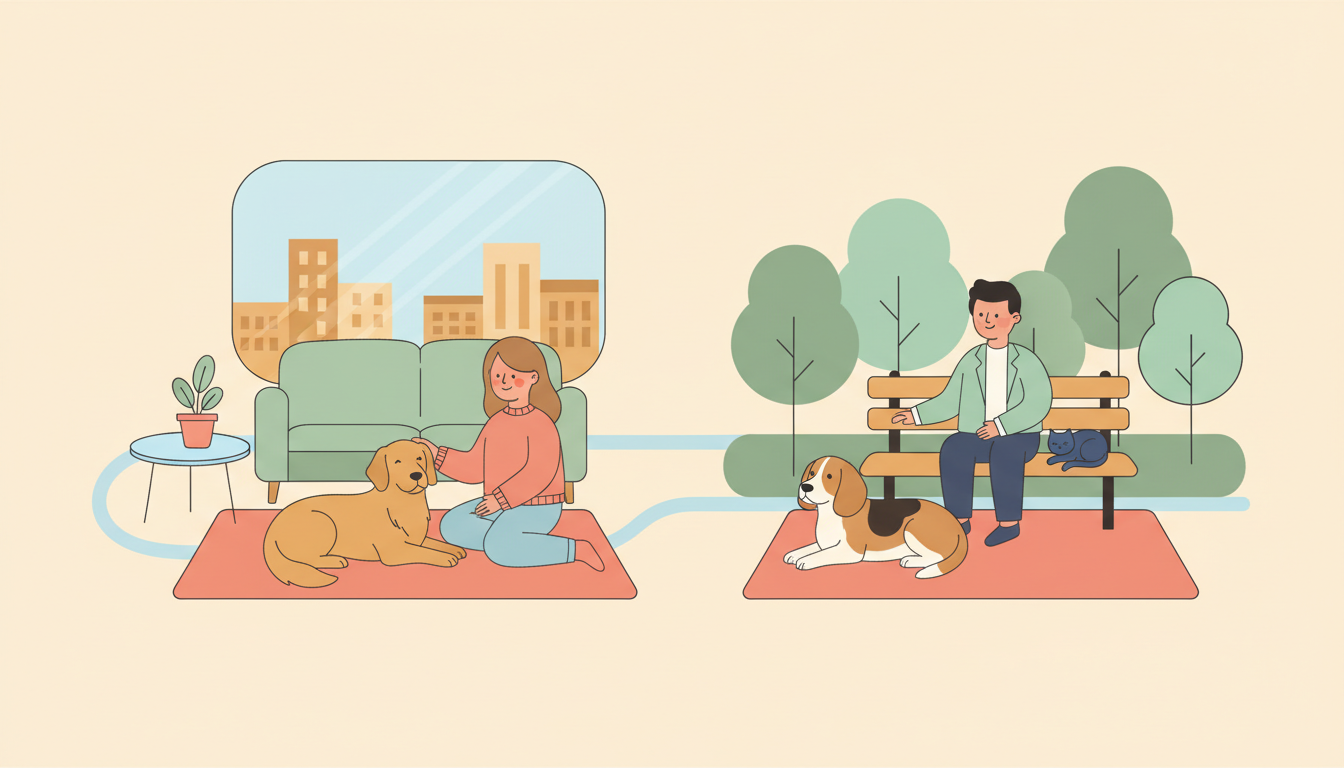
You finally sit down with a coffee, on the sofa or on a bench in a city park. Your dog circles, sighs, stands up and circles again. Every time you stop moving, she starts.
What would it feel like if your dog knew exactly where to go, and how to switch off once she got there? That is the idea behind a simple mat routine, and it is easier to build than you might expect.
This guide walks you through teaching a dog to settle on a mat, step by step. You start at home, then take the same routine out into the world with you.
Why a mat gives your dog a place to switch off
You sit down at a café table. Your dog stands. You shift your bag, and she stands taller. Then she circles, sighs, sits, pops back up. At home it's the same routine on the sofa. Every time you stop moving, she starts.
A mat fixes this by giving her a clear answer to a question she keeps asking: "What should I be doing now?" Over time, the mat becomes a cue that means "you can relax here." She learns to link that spot with calm, and with good things quietly arriving. No commands needed. Just a place that always means the same thing.

Don't expect a one-evening trick. This is a skill you build in short sessions over days and weeks. Puppies, adult dogs and seniors can all learn it, each at their own pace, so don't compare yours to anyone else's.
You don't need much:
- A flat, washable mat or small blanket that travels easily
- Small, soft treats your dog can swallow quickly
- A quiet room to start in, with the TV off and no visitors
One last thing. The mat is never a punishment spot. Your dog should always be free to walk away, and that choice is exactly what keeps the whole exercise positive.
Step by step: building the habit at home
With the basics in place, it's time to start training, and the key is keeping everything small.
Keep every session to a couple of minutes. Pick a quiet room and a moment when your dog is slightly tired rather than wound up, like right after a walk. A dog who's still buzzing won't settle, and that's not a training failure. It's just bad timing.
- Capture. Put the mat on the floor and wait. Whenever your dog steps on it or even glances at it, drop a treat onto the mat. Don't ask for anything yet. You're simply teaching that this square of fabric is a great place to be.
- Down. Once your dog hangs around the mat, reward a sit or a down on it. Deliver treats low and between the paws. If you hold them up high, your dog pops up to meet your hand, and you've undone your own work.
- Relax. When lying down comes easily, start rewarding the quieter signs. A hip roll. A sigh. A head resting on the floor. These tell you your dog is actually switching off, not just holding a pose. Then slow the treats down, bit by bit.
- Cue and build. Only add a cue word once the behaviour is reliable. Pick any word you like, because your dog doesn't care. After that, add small amounts of duration, distance and mild distractions, one at a time.
Keep this short checklist in your head:

- Change one thing at a time.
- End on a success, even a tiny one.
- If your dog keeps getting up, go back a step. Don't repeat the cue again and again.
Three slip-ups come up constantly. First, treating too fast, which keeps your dog alert and chewing instead of settling. Second, adding too much too soon. You walk across the room, your dog follows, and you wonder what happened (you changed distance, duration and excitement all at once). Third, asking for stillness from an over-excited dog. If your dog is spinning or bouncing, the answer isn't a firmer cue. It's a short break, a calmer moment, and another try later.
Making it a real-life skill: doorbells, dinners and TV time
Once the mat works in a quiet room, the next job is making it useful in the middle of ordinary life.
The mat only becomes useful when it works outside training sessions. So practise during the moments you already have. Put the mat near your chair at dinner. Send your dog to it while the coffee machine hisses, or while you answer emails at the laptop. Two minutes here, five there. (It adds up faster than you'd think.)
Build distractions in a sensible order, one step at a time:
- You moving about the room, opening a cupboard, carrying a plate.
- Someone else walking past the mat.
- A knock or doorbell sound played at low volume, then raised gradually over several sessions.
If your dog pops up, you've moved too fast. Drop back a step. No fuss.
For longer stretches, give your dog something to settle with. A long-lasting chew or a stuffed toy on the mat works well, if your dog enjoys them and the treat suits their diet. Not sure? Ask your vet.
Always end the exercise clearly. Pick a release word, say "free" or "okay", and use it every time. The finish should feel as obvious as the start, so your dog knows exactly when the job is done.
Got a cat too? The mat gives your dog a calm place to be while the cat strolls around. Keep things relaxed, and make sure the cat has their own escape routes, like a shelf or a quiet room, so nobody feels cornered.
Taking the mat out and about
When the routine feels solid at home, you can start carrying it with you, which is where a portable mat really earns its place.
Your mat is more than a piece of rubber or fabric. It's a signal. Your dog has learned that calm behaviour on this particular surface pays off, and that feeling travels with it. So keep the same mat and the same routine. Changing both at once asks your dog to learn two things when they should only be learning one.
Build up in a sensible order. Start at your doorstep or in the hallway. Move to the building entrance next. Then try a quiet bench in a park, and only after that busier spots with more passers-by. Skip a step and you'll usually find out quickly (your dog will tell you).
Outdoors is harder than the living room. Squirrels, smells, strangers, scooters. So stack the odds in your favour:
- Start far from distractions
- Keep sessions short, a few minutes is plenty
- Bring higher-value treats than you'd use at home
Watch your dog's body language. If they can't take treats, or they keep returning to the mat instead of settling on it, the setting is too much. Move further away or finish early. Ending a session on a small success beats pushing through a struggle.
And be a considerate neighbour. Keep your dog out of walkways, and keep the lead short enough to be safe. Check local signage and current rules for the places you visit, since they differ from park to park and can change.
Before you head out, run through this quick checklist:
- Mat
- Soft treats
- Water
- Lead and poo bags
- A quiet spot
- A plan to leave if your dog is struggling
When settling stalls: troubleshooting and when to ask for help
Even with a good plan, some days won't go smoothly, and knowing how to respond keeps the whole process positive.
Some sessions just won't click. That's normal. If your dog won't lie down, make the task easier and reward any calm choice, even a sniff of the mat or a soft sit. Then check the basics. Is your dog tired, hungry or in need of a toilet break?
If they keep leaving the mat, shorten the time and treat more often. Don't repeat the cue. Calmly reset the session instead. Still fidgety in easy settings? Look at their day. More exercise, sleep or sniffing earlier on often helps.
Sudden restlessness is different. If it's new, or comes with panting, whining or signs of discomfort, call your vet to rule out a physical cause.
For anxious or reactive dogs, don't push through. Work with a qualified, reward-based trainer who can tailor a plan to your dog.
Above all, keep it positive. Never force your dog onto the mat.
Your first week with the mat, and what to try next
Here's the whole sequence at a glance:
- Introduce the mat.
- Reward the down.
- Reward the calm.
- Add one small challenge.
- Take it outside.
Keep week one tiny. Two short sessions a day in the living room is plenty (five minutes each, tops). End while your dog is still keen, not tired of the game.
So try one two-minute mat session today, at home, and note how long your dog settles. That number is your starting point, and you'll build from it. Next week, pick a quiet outdoor spot for practice, somewhere with few distractions. If your dog finds it hard to relax, talk to your vet or a qualified reward-based trainer.
A settled dog makes café-free benches, quiet evenings and visitors easier for everyone. Be patient, and celebrate every small step. The calm grows with each minute.
Want Pethood on your block?
Pethood is on Google Play. On iPhone? Join the waitlist: one email to confirm, one when it’s on the App Store.
More from the journal.
 Behaviour
The Quiet Signals Your Dog Is Sending You Every Day
A yawn, a lip lick, a glance away: your dog is talking all day. A practical, jargon-free guide to the small signals city dog owners miss, with checklists and a simple five-minute habit.
 Behaviour
Why Your Dog Barks Indoors and What Actually Helps
Dog barking in your flat? Learn why dogs bark indoors, how a one-week diary reveals the trigger, and which calm, practical steps help you and your neighbours.
 Behaviour
Dog Guarding Food, Toys or the Sofa? What to Do Next
Does your dog freeze or growl over a bone, toy or the sofa? Learn the early signs, why guarding happens, and calm, practical steps to help your dog feel safe.