Indoor cat enrichment: making a city flat interesting
Is your cat bored in a small city flat? Practical, low-cost indoor cat enrichment ideas for climbing, hunting play, food puzzles and a weekly routine that fits busy lives.
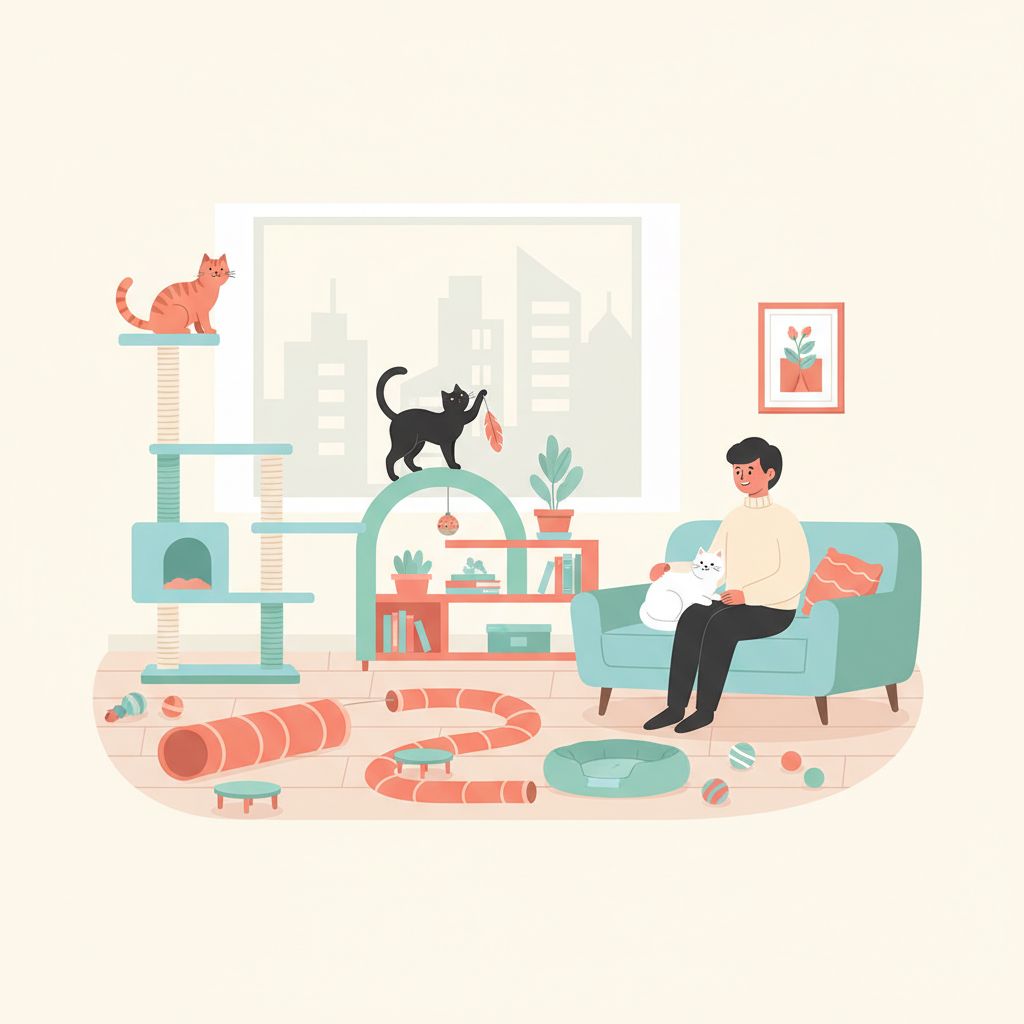
Picture a cat on the windowsill of a city flat, above a busy street in Trešnjevka or a leafy corner near Maksimir. Every pigeon gets tracked and every tram gets followed, until the cat turns back to a room that looks exactly as it did yesterday. That moment is where indoor cat enrichment begins.
So here's a question worth asking: what does your cat actually do all day while you're out?
Enrichment isn't about buying more stuff. It's about giving your cat a job to do: something to hunt, climb, sniff and solve.
The ideas below are practical and low cost, and they're designed to work in small spaces. Most use things you already have at home.
Why indoor cat enrichment matters in a city flat
Indoor cat enrichment means giving your cat daily chances to do what cats are built to do: hunt, climb, scratch, explore, hide and rest. Without those outlets, a bored indoor cat may sleep more than usual, pester you at night or invent their own entertainment, often at the expense of your sofa or plants.
The good news? A small flat can be plenty when you set it up around your cat's needs. Below, you'll find practical ideas on territory, play, food and senses, a weekly routine, and advice on when to involve the vet.

Most of these ideas cost little or nothing. A cardboard box can delight a cat just as much as a fancy cat tree.
Let's start with the space itself, and the dimension most flats leave unused: height.
Think vertical: climbing, perching and window watching
Your cat doesn't see a room the way you do. You see floor space. Your cat sees three dimensions, and every shelf, sill and wardrobe top counts as extra territory. Height gives your cat more room without adding a single square metre.
Start simple. A sturdy cat tree near a window. A few cleared bookshelf ledges as stepping stones. A cushion on top of the wardrobe. And one box or covered bed where your cat can disappear when visitors arrive.
For the window, fix a secure window perch for cats or clear the sill so it looks out on street life, trees or a courtyard. A bird feeder outside, where your building allows it, turns that view into daytime television.

Windows and balconies need a safety check:
- Never leave tilt windows open where your cat can climb into the gap. Cats can slip into that narrowing wedge and get stuck.
- Use secure screens or cat netting on open windows and balconies.
- Check building rules and talk to your landlord or house council before fixing anything to the facade.
Scratching belongs in this plan too. Offer an upright post tall enough for a full stretch, plus a horizontal scratcher. Place them near sleeping spots and room entrances, because that's where cats like to stretch and mark.
Here's how it might look in a one-bedroom flat. Your cat hops from the sofa arm to a low shelf, then onto the cat tree, then up to the window perch. Add one quiet hideaway away from the front door, such as a covered bed in a bedroom corner. Suddenly your flat feels twice its size to your cat.
Once your cat has territory to patrol, the next step is giving them something to hunt in it.
Play like a hunter: short sessions that actually satisfy
Every cat is a hunter, even the one dozing on your radiator. Their play follows a fixed sequence: stalk, chase, pounce, catch. When it comes to indoor cat toys and play, movement matters far more than price.
A toy lying on the floor skips almost all of that sequence. It doesn't move, so it doesn't register as prey. A wand toy in your hand does.
Here's how to run a session that hits every step:
- Move the toy away from your cat. Real prey flees. It never charges at a predator. Drag it across the floor and let it vanish behind the sofa.
- Vary the speed. Freeze, twitch, then dart off. Those pauses are when your cat wiggles and plans the pounce.
- Allow real catches. Let your cat grab the toy every few attempts. Constant misses frustrate rather than satisfy.
- End with a final ‘kill’. Slow the toy down, let your cat catch it, then offer a small meal or treat. Hunt, catch, eat, rest. That's the natural cycle.
Keep sessions short and frequent. Five minutes before work and another ten in the evening beats one long Sunday marathon. Kittens and young cats might want three or four rounds a day, while seniors usually prefer slower, gentler play.
Rotate toys, too. Keep most of them in a closed box and bring out two or three at a time. A feather that's been hidden for a week suddenly feels brand new.
A few safety rules. Put string, ribbon and wand toys away after play, because swallowed string can cause serious intestinal damage. If you use a laser pointer, always end on a physical toy your cat can actually catch.
How do you know it worked? Look for a relaxed body, a quick grooming session and a cat settling down to rest (ideally not on your keyboard).
Play works the body, but your cat's nose and brain need a workout too.
Food, scent and senses: easy enrichment around the flat
Your cat's nose and paws want work, and food puzzles for cats give them exactly that. Start easy. Drop a few treats into an egg carton, or put kibble in a toilet roll tube and fold the ends shut.
Once your cat cracks those in seconds, move up to a proper puzzle feeder.
Better still, split part of the daily ration into four or five small hunts around the flat. A pinch behind the sofa leg. Another on the bookshelf. Breakfast just became a job.
Scent matters just as much. Try these:
- Cardboard boxes from deliveries, which carry smells from warehouses and vans
- A paper bag with the handles cut off, so nobody gets tangled
- A pot of safe cat grass on the windowsill
- A scarf or jumper that smells of the market, the park or a friend's flat
Keep sight and sound fresh too. Rotate which window gets the blinds open, so the view changes. Play a calm radio on quiet days. And rearrange one box or blanket each week, because small changes spark big curiosity.
One firm rule: check every plant before it comes into the flat. Several common houseplants and cut flowers are toxic to cats, and lilies are the worst. Even the pollen or vase water can cause kidney failure.
Older cats or cats with stiff joints need a gentler setup. Lower the perches, add a ramp to favourite spots and keep games on the floor. A slowly dragged toy works fine.
Now let's pull these ideas together into a routine that fits a working week.
A simple weekly enrichment routine for busy owners
Keeping an indoor cat happy is less about hours and more about rhythm. Your cat thrives on a routine they can count on. Here's a daily baseline that fits around a full-time job:
- Two short play sessions (5 to 10 minutes each is plenty)
- One food puzzle or treat hunt
- One window spot open, with a clear view outside
- Fresh water in more than one place
- A clean litter tray
Once a week, rotate toys so old favourites feel new again. Add or move one box. Wash the bedding. And try one new thing, like a fresh hiding game or a supervised visit to a secure balcony.
Say you commute from Trešnjevka to an office in Donji grad. Before you leave, run a quick wand-toy session and finish with breakfast. Then hide a trail of treats around the flat to keep your cat busy while you're out.
In the evening, play once more, serve dinner and let the day wind down with some quiet lap time.
Share your home with a dog? Give the cat dog-free high routes and a feeding spot the dog can't reach. Keep the litter tray well out of the dog's way. And let the cat choose contact rather than forcing it.
Want to go further? Try harness training indoors first, or clicker training for simple tricks like sit or high-five. Go slowly, and only continue if your cat seems comfortable. A twitching tail or flattened ears means you're done for today.
Finally, it's worth knowing where enrichment stops and veterinary care begins.
When to call your vet
Enrichment is brilliant for boredom, but it can't fix a health problem. Cats are experts at hiding pain, so a change in behaviour is often the first clue that something's wrong. No puzzle feeder will solve that.
Book a check-up if you notice any of these:
- Sudden changes in appetite or thirst
- Peeing or pooing outside the litter tray
- Straining in the tray (in male cats, this can be an emergency)
- Overgrooming or bald patches
- Hiding much more than usual
- New aggression, especially from a cat who's normally easy-going
- Limping or reluctance to jump onto favourite spots
- Excessive yowling at night in older cats
This is general guidance only and isn't a substitute for a professional opinion. If you're ever unsure, call your vet. And if your cat seems unwell or in pain, call urgently rather than waiting to see if it passes.
Your three-idea challenge for this week
Your flat might be small, but your cat's world doesn't have to be. The best cat enrichment ideas for small flats are rarely expensive. They're simply consistent.
So here's a gentle challenge. Choose three ideas to try this week:
- One climbing or window change, such as clearing a sill or building a shelf route
- One hunting play routine, like a wand session that ends with breakfast
- One food puzzle, even a humble egg carton
Watch how your cat responds. Some ideas will be instant hits, and others will earn a disdainful sniff. Keep what works, adjust what doesn't, and build from there.
If any change in behaviour worries you along the way, see your vet. With a little thought, indoor cat enrichment can turn a city flat in Zagreb or anywhere else into a rich, interesting home.
Want Pethood on your block?
Join the waitlist. One email to confirm, one on launch day, nothing else.
More from the journal.
 Behaviour
 Dogs and Children: Safe, Calm Daily Routines at Home
Practical steps for keeping dogs and children safe at home: a safe dog space, body language lessons for kids, calm daily routines and clear supervision rules for families.
 Health & vet
 Dog and Cat Grooming at Home: A Simple Starter Routine
A simple starter routine for grooming your dog or cat at home: brushing, nails, ears and paw care for city pets, with short sessions, calm habits and clear signs it's time to call your vet.
 Training
 Puppy Socialisation Checklist for City Life
A practical, tickable puppy socialisation checklist for city life: sounds, surfaces, people and traffic, with a one-week plan to build a calm, confident urban dog.